
JP
EN
MENU

Interview

Pioneering Transformative Technologies
Toward the Integration of Recognition, Control, and Learning

Principal Researcher,
Research & Development Group

Ikuro Sato, Ph.D.

Establishing an 'Outpost' Beyond the Cutting Edge at a University

Why a university-based research hub matters for zero-to-one exploration

The idea of building a research presence at a university emerged from internal discussions with Iwasaki-san and Ambai-san around the question of what ITLAB should be as DENSO Group’s advanced software research and development organization. While research that closely aligns with customer needs is essential, we also have a strong need to strengthen exploratory research capable of radically transforming existing approaches. We felt that universities offer fertile ground for such potential, and envisioned establishing an ‘outpost’ within a university that could push even further beyond the cutting edge of advanced research. At the time, I was exploring a number of research ideas in image recognition and deep learning within the company. Building on my collaboration since 2014 with Professor Satoshi Matsuoka at the Institute of Science Tokyo (formerly Tokyo Institute of Technology) on large-scale parallelization of deep learning using supercomputers, we decided to establish a collaborative research chair at the university.

A University Base Enables Research in Breadth

Advancing multiple research themes in parallel through academia and industry collaboration

At the collaborative research chair, our objective has been to develop perception technologies capable of substituting for human visual recognition. Not only for driver assistance and autonomous driving, machine perception is also becoming essential in domains where robotic automation is expected, such as product inspection and work support in factories. Developing high-accuracy perception is therefore a critical challenge for enabling intelligence across a wide range of machines.
Our themes span a wide spectrum from fundamental theory to applied research. These include foundational topics such as feature extraction theory and brain-inspired memory models, as well as more application-oriented research on first-person perception, multimodal recognition, and shape recognition.

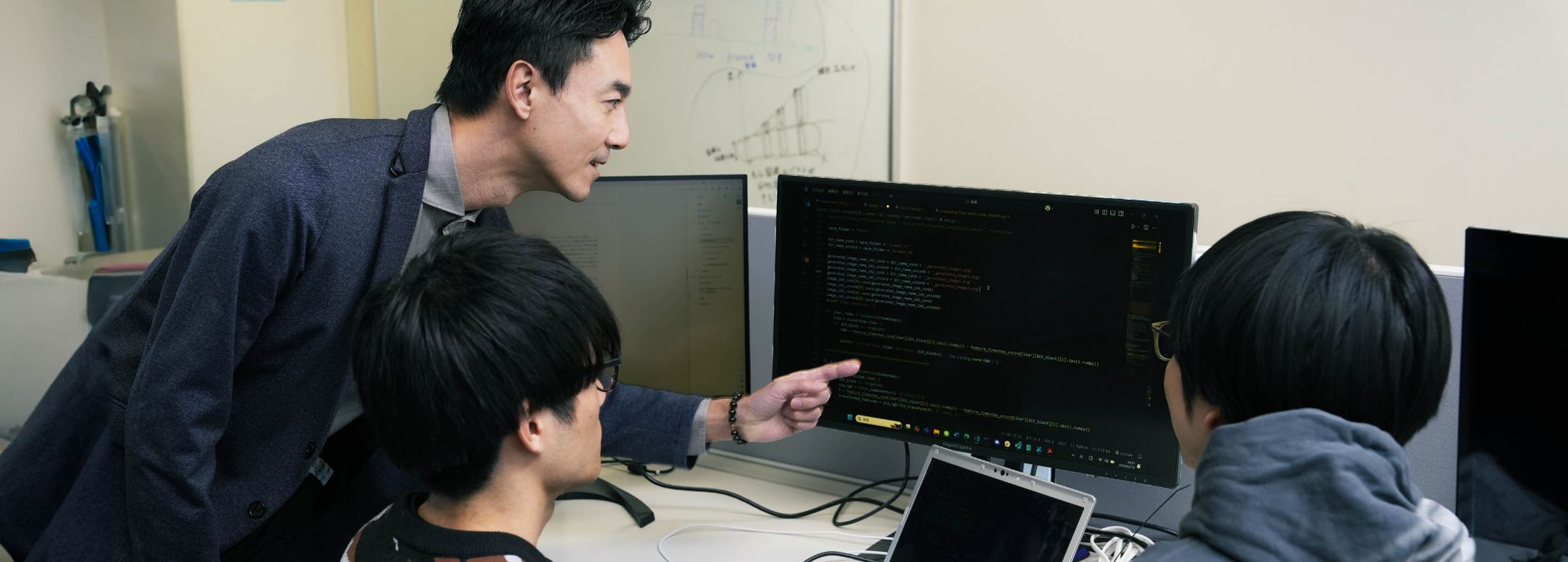
Currently, my laboratory consists of 11 graduate students, and when including students from other collaborating laboratories and interns, the team comprises approximately 20 members. In addition, around 10 faculty members from the Institute of Science Tokyo participate as collaborative researchers.

One of the key advantages of conducting research together with many faculty members and students is the ability to pursue research in breadth. If I were working steadily within the company on my own, I might be able to handle only one or two themes per year. Now, however, we are able to pursue nearly twenty research themes in parallel. As AI research continues to expand and diversify, pursuing breadth rather than a single breakthrough is essential for exploratory research. For companies, maintaining a research base at a university offers a major advantage in this respect. Any ITLAB researcher can leverage this chair, and to date, seven researchers have formed working groups with students and produced research outcomes through active discussions.

Toward the Integration of Perception, Control, and Learning

Expanding from perception to action to pioneer next-generation technologies

The themes of the chair are not necessarily aimed at immediate industrial application, and therefore do not lead directly to product development. Nevertheless, I believe there is significant value in positioning exploratory research as an explicit organizational objective. At DENSO, including at the executive level, there are many people with a keen sense for technologies, constantly alert to the emergence of game-changing breakthroughs. If a radical innovation that diverges from current technological directions were to emerge and become the new norm, it is crucial to detect its early signs. One of our important roles is to inform their strategic vision.
We have built a strong connection with DENSO by sharing the big picture of where the industry needs to go and the challenges that must be solved to achieve it. Through regular exchanges with AI Research Group at DENSO, we actively discuss and share our accumulated know-how and the latest insights in a timely manner.

Five years after the establishment of this chair in April 2020, we entered a second phase in April 2025 as the ‘DENSO IT LAB Recognition, Control and Learning Algorithm Collaborative Research Chair.’ While our research to date has focused broadly on visual perception, we are now expanding our scope to include the next step—’acting on what has been perceived’—by adding control as a core research theme. We are pleased to welcome Kenta Hoshino, a young researcher in control, as a new member, and are actively advancing new research that integrates perception, learning, and control. We welcome researchers who wish to take on the challenge of pioneering breakthrough technologies in this field.

Join Our Research at DENSO ITLAB

Where engineering curiosity
meets real-world impact

Careers