
JP
EN
MENU

Interview

Aiming for Real-World Implementation
In an Environment with Many Paths to Application

Principal Researcher,
Research & Development Group

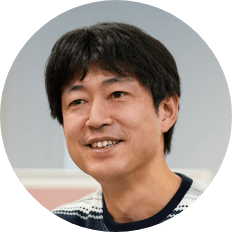
Mitsuru Ambai, Ph.D.

Turning Research into Real-World Deployment

What motivates me most is seeing my research put into practical use.

Since joining the company in 2007, I have worked on image recognition technology and its applications. From early on, my interests have leaned toward applied research rather than pure theory. My doctoral research, for example, focused on detecting vehicles from surveillance camera footage installed along roads to measure traffic flow. I also worked part-time at a startup company, where I was involved in product development using image recognition technology. Our team worked together on everything from algorithm design and performance evaluation to building demo systems, pitching to investors, and ultimately implementing the technology as a product. It was a highly fulfilling and enjoyable experience. Through these experiences, I realized that I am more motivated by seeing my research outcomes implemented and used in society than by pursuing theory alone.

My current focus is model compression—techniques for reducing the computational load of AI models so that they can operate with lower power consumption and reduced memory requirements. As AI models become more accurate, their computational load increases, leading to higher memory and power consumption. However, in-vehicle devices have strict limitations on both memory capacity and power usage. Model compression is therefore essential for bridging the gap between the computational burden of state-of-the-art AI and the performance constraints of in-vehicle devices, enabling outcomes of cutting-edge AI research to be implemented in real vehicles. The challenge of balancing AI performance with power efficiency will become increasingly important across many sectors of society, and techniques that reduce computational load to enable deployment on constrained chips can be applied far beyond automotive systems.

Fundamental Research with an Eye Toward Broad Deployment

It’s a joy to see research find its way into unexpected places.

Even after joining ITLAB, I have continued to conduct fundamental research in image recognition, with clear applications in mind. ITLAB researchers typically blend two research styles in their own way. One is seed-driven research that focuses on technological possibilities, and the other is need-driven research that responds to business unit requirements. In my case, while I incorporate both perspectives, I tend to lean toward the seed-driven style. I conduct fundamental research with the expectation that the resulting technologies can be broadly deployed across multiple domains.

The first time I felt confident that a technology had strong potential was in my research on local feature descriptors, which I began in my third year at the company. This foundational technology is used to identify common regions between two images and is widely applied in image retrieval. Presenting the work at academic conferences helped it gain visibility outside the company. When I introduced it to DENSO and proposed applications, it was adopted in the field of factory automation. Some related products are still under development.

In some cases, interest in fundamental research emerges more than ten years after it is first presented. Among the technologies transferred to DENSO, there are even some whose full details I no longer completely track myself. At events such as the annual Lab Exhibition, which is an internal technology showcase, hearing from the engineers who took it over that my work is being used in unexpected ways makes me feel like watching my own child grow.

Conversations Reveal Needs

With experience in both research and product development, years of conversations help me connect academia and business groups.

I believe that my ability to understand what technologies are truly needed today comes from having conversations with many people over the years. ITLAB is an independent subsidiary that serves as the research arm of the DENSO Group, and when I first joined, I had opportunities, often more than once a week, to present my research to visitors from DENSO headquarters as well as from inside and outside the group. At the Lab Exhibition, I also introduce my research to members of various DENSO business groups. These interactions often lead to questions such as, “Could this technology be applied to this problem?”—creating new points of connection. Over the past seventeen years, I have built relationships across many parts of the DENSO Group through these conversations, and I continue to exchange information regularly. As needs become clearer, when I sense that another ITLAB researcher’s work might be a good fit for a particular challenge, I often introduce them, which can lead to new collaborations.

When talking with members of business groups, I try not only to listen to their challenges but also to bring in insights from the latest academic research and translate those insights in a way that is clear and relevant to their work. I believe my ability to serve as a bridge comes from having gained experience in both worlds early in my career. I work with engineers who understand the realities of product development and embedded system constraints, and also work with ITLAB researchers who publish at top-tier AI conferences, including Sato-san through our collaborative research chair with the Institute of Science Tokyo.

Practical Technologies Are Built on Deep Theoretical Insight and Strong Fundamentals

ITLAB offers many opportunities to pursue fundamental research and bring results into implementation with the DENSO Group.

I believe that information science research should naturally lead to application. Fields such as computer vision and image recognition have evolved with practical use in mind. That does not mean fundamentals can be overlooked. In fact, achieving real-world performance requires a strong foundation in deep theoretical insight and fundamental technologies. At the same time, in organizations devoted solely to research, it can be difficult to find opportunities for applying research outcomes. In contrast, the DENSO Group encompasses a wide range of products and industries—including autonomous driving, ADAS, and manufacturing technologies—providing abundant opportunities to explore real-world applications. For researchers who wish not only to develop algorithms and technologies that are recognized at top conferences but also to take the next step toward real-world implementation, I believe ITLAB offers a highly rewarding environment.

As for my own current application pathway, I am working with DENSO business groups on projects that involve deploying AI computational load reduction technologies in automotive systems. We have a roadmap in place, and I intend to steadily advance the research toward those goals. If the technology is adopted, I would love to buy the car myself and take it out for a drive.

Join Our Research at DENSO ITLAB

Where engineering curiosity
meets real-world impact

Careers