JP
EN
MENU

Interview

A Teal-inspired Organization Where Each Individual Takes Ownership of Company Management

CTO

Katsumasa Nishii

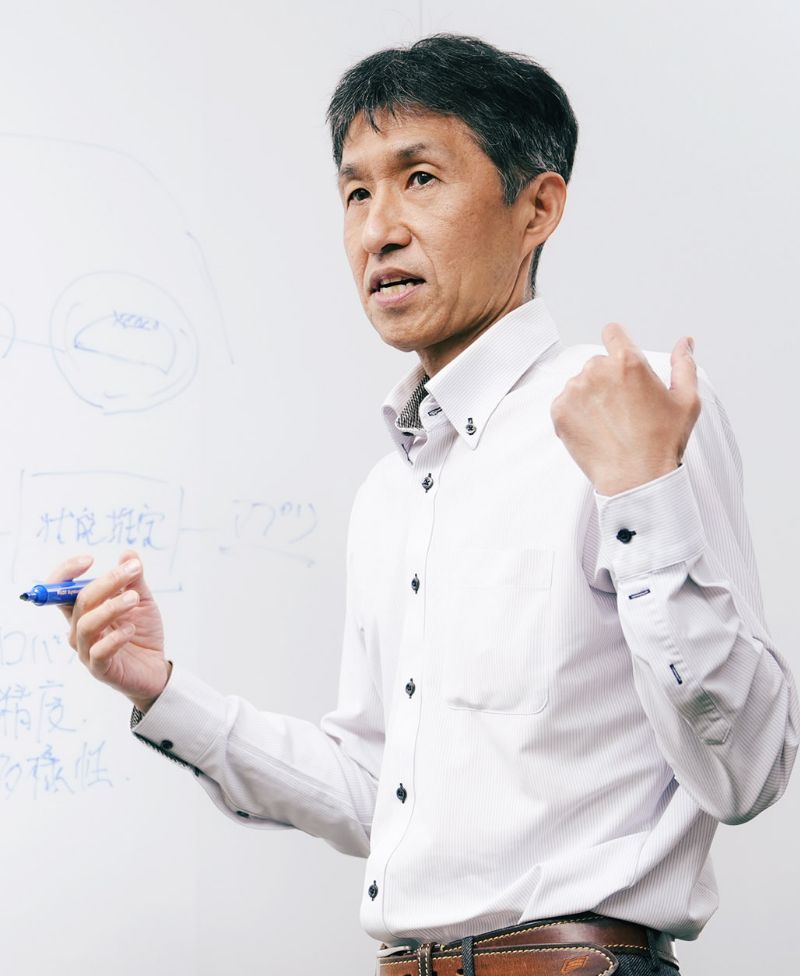
At DENSO IT Laboratory (ITLAB), a Teal-inspired organizational structure with minimal hierarchical layers has been adopted. This approach responds directly to researchers’ desire to focus on research itself. So how, exactly, is ITLAB managed under this structure? We asked CTO Katsumasa Nishii to share his perspective.

Rather than assigning roles to departments, individuals define their own roles

A flat structure that empowers researchers to define and take ownership of their roles.

In a typical company, a hierarchical organization is established, roles are assigned to each department, and managers oversee operations. At ITLAB, however, our headcount is relatively small, and the majority of our members are researchers who are strongly motivated to devote themselves to research. We initially tried a conventional corporate management style, but it did not work well for us. As we explored alternative approaches better suited to our organization, we encountered the concept of the Teal organization.

A Teal organization is a flat organization without hierarchical layers. Instead of creating fine-grained departments by research field, we work in units we call “research clusters.” Any researcher can propose and launch a research cluster. Each cluster represents a research challenge: an individual defines the theme and then gathers colleagues who wish to work on it together. Rather than departments being assigned roles, individuals autonomously identify and take on roles themselves. Because there are no managers, each person must maintain a strong sense of self-management. For example, responsibility for research progress is shared by the cluster as a whole.

Perhaps because ITLAB is known across various academic communities, many of the people who join us aspire to pursue cutting-edge research. For such individuals, becoming a manager may feel at odds with why they joined in the first place. By adopting a Teal-inspired organization that minimizes hierarchy, our aim is to provide an environment where researchers can concentrate on research, continue working as independent researchers throughout their careers, and at the same time ensure the long-term sustainability and growth of ITLAB by establishing its distinct identity.

Managing the company together, rather than leaving it to someone else

Company operations and governance are shared collectively through flat, participatory committees.

Research clusters alone cannot sustain the operation of a company. For this reason, we have established various committees responsible for operational and administrative functions. These committees create rules that form the foundation for a comfortable working environment and smooth organizational operations. Decisions made by committees become official company policies, which means that anyone can help transform the company through committee activities. Like research clusters, committees are also flat and non-hierarchical, making it easy for members to speak up and share opinions freely. Requests are readily taken on board, so improvements and reforms tend to happen quickly.

Each committee requires someone to serve as a leader, and taking on this role further strengthens one’s sense of self-management. Our philosophy is that company management should not be left to a select few, but carried out collectively by everyone. This is how we think about governance at ITLAB.

A reverse mentoring system that allows individuals to choose their own mentors

Researchers proactively design their own career paths by selecting mentors aligned with their goals.

When someone joins ITLAB, they are assigned both a mentor and a support advisor. The mentor provides guidance on research, while the onboarding advisor explains company systems and rules. In addition to this, we have a reverse mentoring system. When a researcher reflects on their own career path and thinks, “I want to acquire this skill,” or “I want to learn from someone with expertise in this area,” the system allows them to nominate the mentor they wish to learn from. This system also plays an important role in strengthening each individual’s sense of self-management.

Join Our Research at DENSO ITLAB

Where engineering curiosity
meets real-world impact

Careers